February 3, 2026
Swing vs. Slide: Choosing a Driveway Gate on the Coast
By Coastal Concepts Construction · 3 min read
Swing gates and slide gates each win in different situations — driveway slope, space, wind exposure, and salt air all matter. Here's how we help Wilmington-area owners choose.
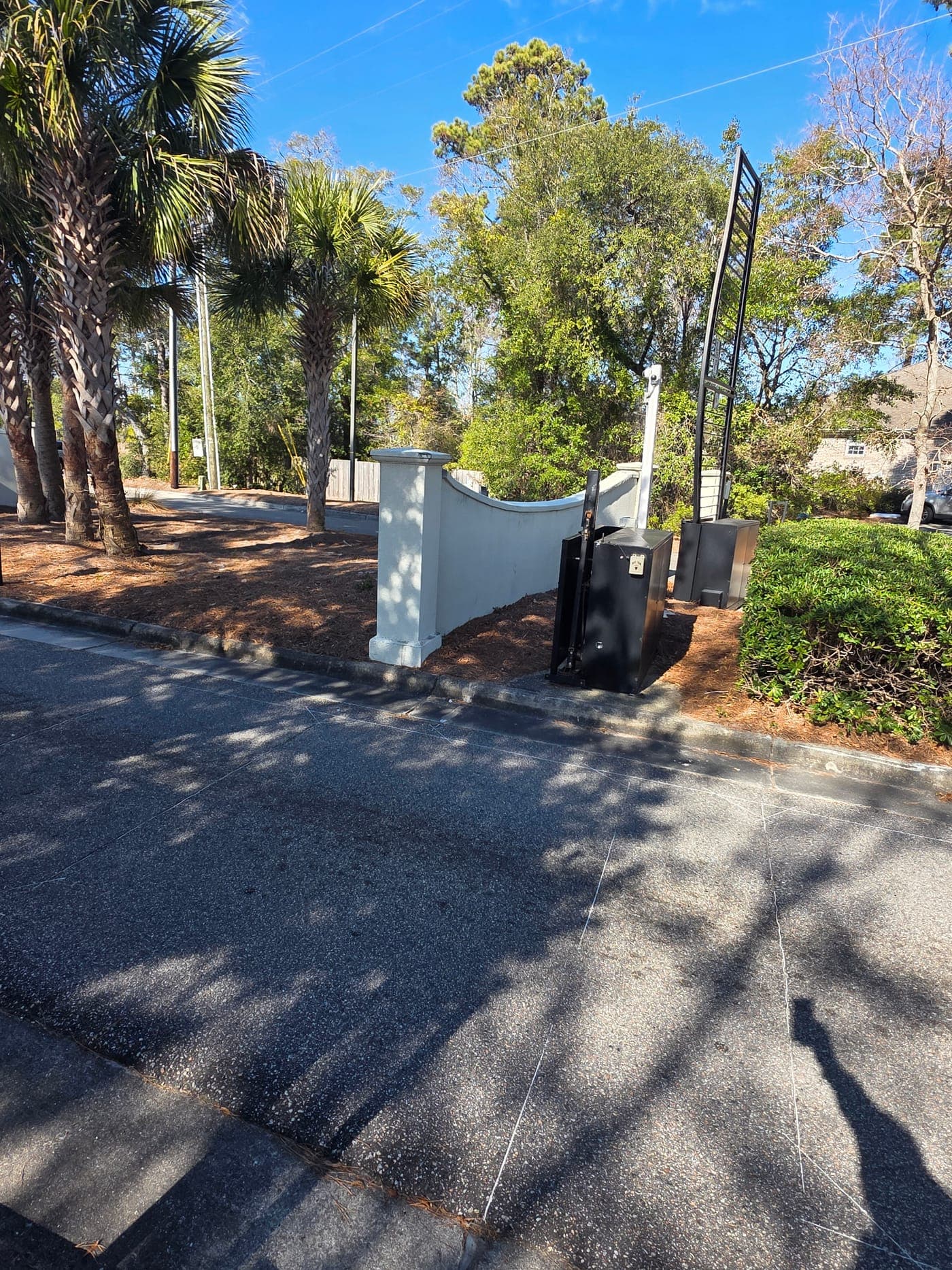
When someone calls us about a new driveway gate, the first question is almost never the one they expect. It's not "wood or aluminum" or "keypad or phone app." It's: does your site want a swing gate or a slide gate? Get that one right and everything downstream — operator choice, maintenance, lifespan — gets easier. Get it wrong and you'll fight the gate for as long as you own it. Here's how we walk through it on coastal properties.
How Each Type Works
A swing gate operates like a door: one or two leaves on hinge posts, swinging (usually) inward. An arm or ram operator pushes and pulls each leaf.
A slide gate rolls sideways along the fence line, on a ground track or as a cantilever that hangs from rollers and never touches the ground. A chain- or gear-driven operator moves it.
Both are proven. The site decides which one belongs.
The Site Questions That Decide It
Slope. The most common disqualifier. A swing gate needs the ground under its full arc to be flat or falling away — a driveway that rises behind the gate means the leaf grounds out before it opens. Slide gates only care about the line they travel, so sloped driveways usually point to a slide.
Space. Swing gates need their arc clear: for a 16-foot double-leaf gate, that's an 8-foot-deep clear zone nothing can park in. Slide gates need run-off room along the fence line equal to the opening width. Short setbacks off a busy road favor slides (a car can't wait in the arc); tight side yards favor swings.
Wind. This one matters more here than in most markets. A gate is a sail, and solid-infill designs catch enormous loads. Swing gates take wind worst — a gust hitting an open leaf levers the full force onto hinges and operator arms. Slide gates present the same face regardless of position and shrug off wind far better. On exposed sites near the water or open marsh, that pushes us toward slides or toward open-picket swing designs that let wind pass through.
Cycles. A family driveway sees a dozen cycles a day; a shared drive or small community sees hundreds. High-cycle duty favors slide gates and commercial-grade operators.
The Coastal Maintenance Reality
Salt air changes the long-term math.
Swing gates are mechanically simpler — hinges and an operator arm — but sagging leaves are their signature failure, and salt-corroded hinge hardware accelerates it. A sagged leaf binds, and an operator straining against a binding gate dies young.
Slide gates carry more hardware: rollers, track or cantilever trucks, chain. Ground tracks collect the sand that's part of life here, so on this coast we lean toward cantilever slides — nothing touches the ground, so there's no track to clean and no sand to grind through. The tradeoff is a longer counterbalance run and a somewhat higher build cost.
Either way, materials matter more than type: aluminum or hot-dip galvanized steel frames, stainless hardware, and marine-grade fasteners are what actually survive within a couple miles of salt water.
Whatever You Choose, Two Non-Negotiables
Safety devices. Any automated gate should be installed to the UL 325 safety standard — photo eyes and/or sensing edges so the gate can't close on a car, a pet, or a person. We won't automate a gate without them.
Power planning. Storm-season outages are a fact of coastal life. Battery backup sized for real cycles — and a manual release everyone in the house knows how to use — means the gate never traps you in or out.
Rough Numbers and Next Step
Complete automated gate systems vary widely with size, material, and site work, so we quote them only after seeing the property. For existing gates, most repairs run $250 to $1,800. If you're weighing swing versus slide for a new install — or fighting a gate that was the wrong type from day one — request a site visit at /estimate and we'll give you a straight recommendation and a free written estimate.
Pricing a project?
Get an instant range
Pick your project type and see a real price range in seconds — based on jobs we’ve actually completed around Wilmington.
Common questions
Which handles coastal wind better, a swing or slide gate?
Slide gates, generally. An open swing leaf takes wind like a sail and levers the load onto its hinges and operator. If a site is exposed and a swing gate is still preferred, an open-picket design that lets wind pass through beats solid infill by a wide margin.
What is a cantilever slide gate and why use one near the beach?
A cantilever gate slides on rollers mounted to posts and never touches the ground — no track across the driveway. That matters on the coast because ground tracks collect sand and debris that grind rollers and jam gates. Cantilevers cost more up front and need less cleaning forever after.
Do automatic driveway gates work during power outages?
They should. A properly specified system includes battery backup that covers a realistic number of cycles, plus a manual release for when batteries are exhausted. On this coast, where storm-season outages are routine, we consider backup power part of the base system, not an option.