January 6, 2026
Deck Footings in Sandy Soil: How We Build on the NC Coast
By Coastal Concepts Construction · 4 min read
What sandy coastal soil means for deck footings, and how footing depth, diameter, and uplift hardware are handled in southeastern North Carolina.
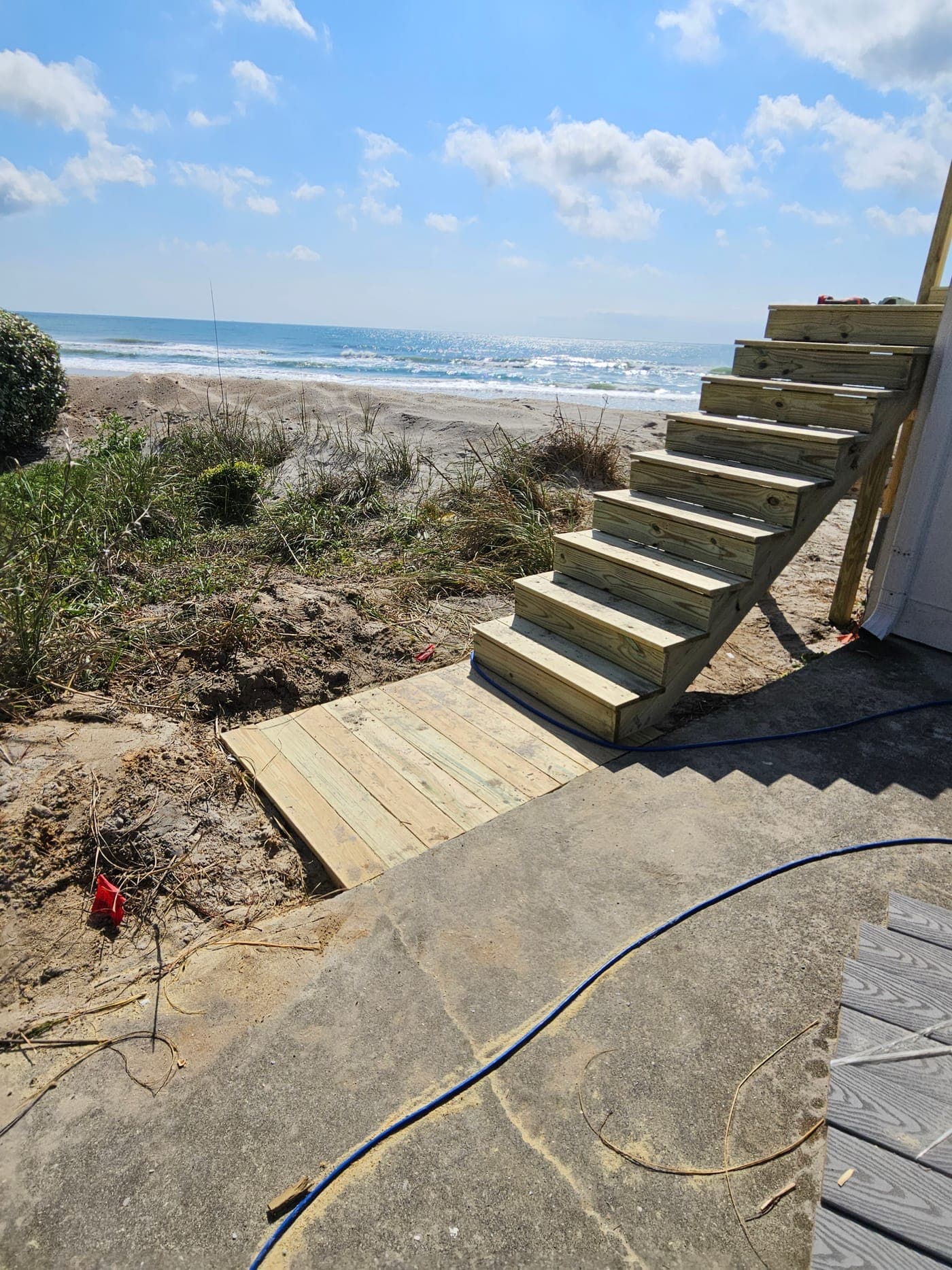
Nobody ever compliments a footing. It's a hole full of concrete that gets buried and forgotten. But footings are the difference between a deck that shrugs off twenty years of coastal weather and one that leans, bounces, or lifts in a storm. Building on the sand-heavy soils of New Hanover, Pender, and Brunswick counties changes how we approach them, so here's what's happening under your deck.
The good news about sand
Sandy soil gets a bad reputation from a certain parable, but for deck footings it has real advantages. Sand drains freely, which makes it far less prone to frost heave than clay, and North Carolina's code minimum footing depth is a modest 12 inches to the bottom of the footing, one of the shallowest in the country, because our frost line is shallow. Compared to contractors up north digging four-foot holes, we have it easy on depth.
Clean, compacted sand also bears load predictably. Plenty of very heavy buildings around Wilmington sit happily on sandy ground.
The catch: bearing, washout, and uplift
Three things keep sandy-soil footings from being simple.
Bearing area. Loose sand has lower bearing capacity than dense soil, so a skinny footing can slowly sink under a loaded deck, and you notice it years later as a dip in the corner or a stair pulling away. The fix is not depth so much as width: a larger-diameter footing spreads the load. Where we hit loose or disturbed fill, we upsize the footing rather than hope.
Water movement. Near the beach and along tidal creeks, moving water can rework sand around shallow footings. On low-lying lots at places like North Topsail or near the Intracoastal, we account for drainage patterns and, in flood-prone spots, follow the stricter foundation rules those zones carry.
Uplift. This is the coastal one. Inland decks mostly need to be held up. Coastal decks in our high-wind region also need to be held down, because hurricane-force wind gets under an raised deck and tries to lift it like a wing. That means footings sized with some mass, positive post-to-footing connections rather than posts resting in dirt, and hot-dip galvanized or stainless connectors that will still be doing their job in year fifteen. A perfect footing connected with a rusted bracket is a failed footing.
How the process actually goes
On a typical deck build, we lay out the footing locations, dig, and then call for the footing inspection; the county inspector looks at every hole before any concrete is poured, checking depth, diameter, and soil at the bottom. In sandy ground the holes want to slough at the edges, so we dig and pour promptly rather than leaving open holes through a rainy week.
If we hit something unexpected, buried construction debris, an old stump, or muck instead of sand, we deal with it then: over-dig and compact, relocate the footing on the plan, or upsize. This is exactly the kind of thing that separates a permitted, inspected deck from a handshake job, because the inspector and our own standards both force the issue while it's still a $100 problem.
What about helical piers and precast footings?
For most residential decks here, poured concrete footings are the right tool: proven, inspectable, economical. Helical piers earn their cost on soft or organic soils, on remodels where machine access beats hand digging, and on some waterfront lots; they're screwed to refusal and provide excellent uplift resistance. Surface-set precast blocks, the kind sold for "floating decks," are not something we use on anything raised or attached to a house in this wind region.
Questions to ask any deck builder
What diameter and depth are the footings, and who inspects them? How are posts attached to footings? What hardware grade near salt water? A builder who answers those crisply will get the rest of the deck right too. If the answer is "we set the posts in the ground and pour concrete around them," ask how that post is supposed to be replaced when it rots at grade.
Planning a deck on the coastal soil around Wilmington? Request a free written estimate at our estimate page. We'll assess your soil and site as part of the visit, and the footing spec will be in the estimate where you can see it.
Pricing a project?
Get an instant range
Pick your project type and see a real price range in seconds — based on jobs we’ve actually completed around Wilmington.
Common questions
How deep do deck footings need to be in coastal North Carolina?
North Carolina's code minimum is 12 inches to the bottom of the footing, shallower than northern states because our frost line is shallow. Depth is rarely the issue here; footing diameter for bearing and hardware for wind uplift matter more in sandy soil.
Is sandy soil bad for deck footings?
Not inherently. Sand drains well and resists frost heave, but loose sand bears less load, so footings often need a wider diameter, and coastal wind uplift requires positive post-to-footing connections with corrosion-resistant hardware.
Do deck footings get inspected?
Yes. On permitted decks in New Hanover, Pender, and Brunswick counties, the footing holes are inspected before concrete is poured, and framing is inspected before decking covers it. We schedule and meet those inspections on every project.